
If music is the food of love, food (and drink) could as well be the sound of music in Austria.
The Croissant
More austrian than french
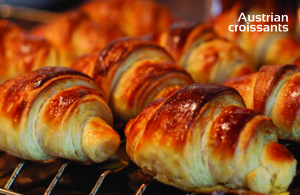
While the French may smirk at the idea, the history of the croissant is disputed. Austrians have been credited with creating this popular item on the breakfast table. It is said that in 1683, during the Ottoman Turks siege of Vienna, a baker working late at night heard the Turks tunneling under the walls of the city. He alerted the military which saved the city from invasion.
To celebrate the victory, the baker baked a crescent shaped pastry, called Kripfel, in the shape of the Turk’s Islamic emblem, a crescent moon, so that when his fellow Austrians bit into the croissant, they would be symbolically eating the Turks.
Another story talks of an Austrian artillery officer who opened up a bakery in France and popularized many Austrian foods, including the Kripfel. Experts argue that Viennoiseries, another lookalike, were made popular in France by the Austrian August Zang when he opened a Viennese bakery in Paris, possibly in 1838. French bakers began imitating his Viennese pastries, and the “Kipferl” became “Croissant”, which is French for “crescent”.
Another story says that Marie Antoinette missed the Kipferl so much that she brought a Viennese baker to Paris to teach the Parisian bakers how to make them. Probably that’s true, since like her, we also lost our heads savouring Austrian bread and confectionery. Thankfully, we retained our heads.
A savoury spread
Hanging out at hangar 7
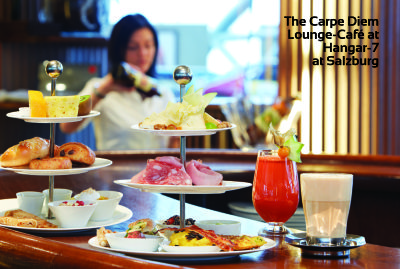
The Carpe Diem Lounge-Café at Hangar-7 at Salzburg, immediately next to the Flying Bulls’ awe-inspiring historical aircraft transforms a simple espresso into an allround sensory experience. The special Currywurst with French fries along with a host of sandwiches, Flame cake with smoked salmon and leek and mustard-cucumber-salad, amongst others, can be enjoyed at Hangar 7, the smart venue that presents an interesting social, events and dining experience at Salzburg. The menu includes cake in a glass, besides coffee and the daily newspaper.
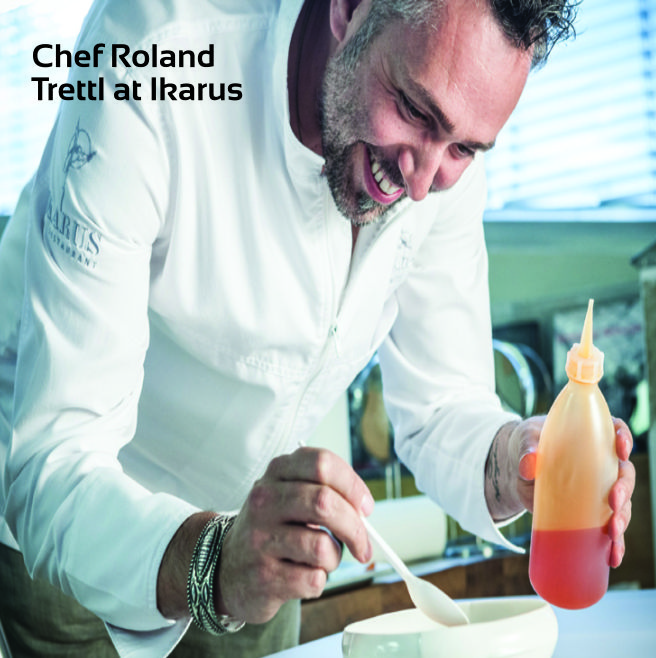
At the same venue, The Ikarus restaurant sees the magic of Chef Roland Trettl unveil new idioms in cuisine with guest celebrity chefs every month. The restaurant is a star attraction for visitors. The chef behind it all, Roland Trettl, was born and raised in South Tyrol. He wanted to be either a professional ice-hockey player, or a chef. Fortunately for the cuisine world he chose the latter. Traveling with some of the world’s hottest chefs, Trettl spent up to one hundred days a year in airports and the kitchens of other chefs to learn from them for Restaurant Ikarus. While the food, predictably, is excellent, the surprise often comes with the starters and breads as well. Not to mention desserts and the coffee or tea, that can be as stylish as it could get.
Confectionery beyond compare
Mozart’s balls
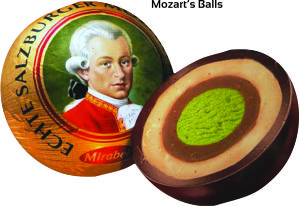
One can’t emerge from Salzburg without them. Mozart’s music and the chocolate-covered nutty flavored balls that bear his name is everywhere in Salzburg’s Altstadt (Old Town) district.
Those in the know say that the handmade Mozartkugels, are the ones wrapped in blue-silver tin foil. The red-gold tin foil varieties are imitations of the original exquisite tasting chocolate truffle created in 1890 by Salzburg confectioner Paul Furst. Not that it changes the yummy treat in any way.
Each ball has a green pistachio marzipan core covered in a layer of nougat. The creamy, nutty center is then pierced with a small wooden stick and coated with a thick layer of dark chocolate. The stick is removed after the chocolate hardens, the small hole covered with chocolate, and the balls are wrapped in shiny foil. It is all done by hand in the original sweet. The confectionary has won lots of awards, starting with one at Paris in 1905. Today, they are everywhere, with Mozart’s face emblazoned on them.
Few visitors leave Salzburg without them. The red bright boxes and gold covered balls are in every bag checking out of Salzburg.
Dairy flavours
Saying cheese at zell am see
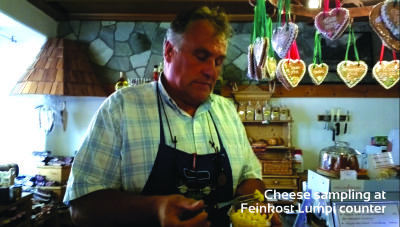
Zell am See could be Austria’s well kept secret- in India, at least. It’s a destination that offers a lake cruise, mountain drive and a glacier ride and skiing- all in a day. However, amongst its many joys, cheese is also a celebrated pleasure.
The picturesque village of Zell am See (a fast growing tourist destination for water and winter sports) holds a farmers’ market on the town square every Friday, where besides cheese; farm produce of different varieties is sold in droves. Most cheese in Austria is produced by cooperatives and private individual farms using traditional methods, some recipes being handed down from generation to generation. With a freshwater lake from which you can practically drink water directly and with grass grown in naturally organic hillsides, the milk from the dairies is indeed perfect.
The innovative processes of its making helps transform cheese into unique cream cheese creations made from cow’s, sheep’s and goat’s milk, combined with herbs, fruits or vegetables. Each region of the country offers its own specialties, based on century-old recipes adapted to suit the modern palate as well. There are other offerings of a particularly extensive range of cheeses and flavoured cheese dumplings, not to mention handmade Berger chocolates. Our favourite, however, was the excellent cheese available in a mind boggling variety.
As the pleasant man at the counter of Feinkost Lumpi, the popular shop, enjoins us to taste a few samples, we end up buying some to take away for those at home- only to realize later that we had nibbled it all before we got back!
Tyrolean delight
Breaking bread at grand europa:
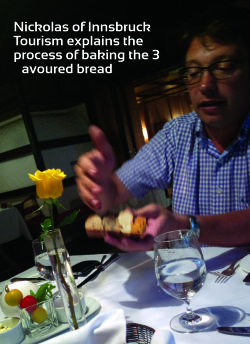
When a Tyrolean would pray, he would probably say- Lord, Give us this day our daily bread (but make it in the three flavours, please). As we sat down for dinner at the centuries old restaurant at the Grand Europa in Innsbruck, the capital of the Tirol region of Austria on the very first night, the champagne was a delight/wine was delight, but the bread basket was so good, it called for an encore. The Grand Europa Hotel is Innsbruck’s delicious piece of history that sits right across the main rail station. Hosting kings and Presidents, since its establishment in 1869, it is now renovated and expanded but the aura is kept intact with history lurking in every corner.
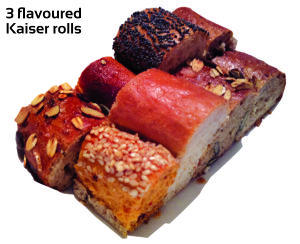
Now baking bread is as Austrian as it can get. The shape of the Kaiser rolls have five sections that have a tendency to blend together as the roll bakes. Sometimes the surface is dusted with rye flour prior to baking, which helps to hold the shape as it bakes. They are also known as Vienna rolls. The ones served at our table was simpler bread but with three distinct colours and flavours in each piece.
The bread is raised fresh daily in the hotel’s own bakery. The three flavoured bread, says Nickolas of Innsbruck Tourism, is so easy to bake. Just knead the dough in three different flavours and lump them together when it is baked. Sounds simple enough, but not many bakeries can spin out the consistency and flavours as the one at Grand Europa.
Well, if it was good enough for the Bavarian king Ludwig or King Gustav of Sweden who dined at the same restaurant, it’s fine for us as well though we don’t know if royalty would have ever asked for second helpings of the bread basket! With no imperial graces or royal attitudes to protect or worry about, I sure did..